
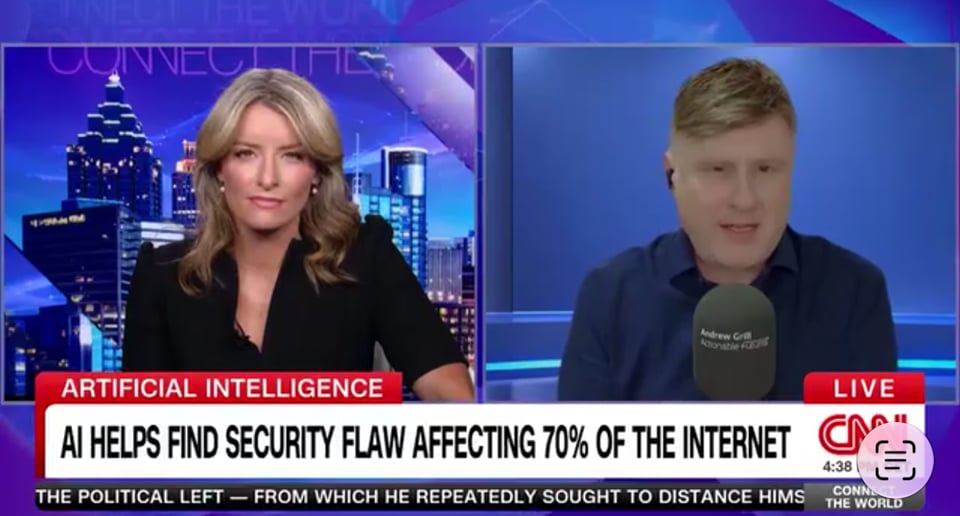
Andrew joined Lynda Kinkade live on CNN International’s Connect the World from London. The segment covered three stories about how AI is reshaping the tech industry. AI had helped uncover a critical flaw in PHP, the software behind huge numbers of websites. Barclays had announced 5,000 job cuts. And a New Mexico judge had ordered Meta to pay $25 billion over Cambridge Analytica. The thread running through all three: AI is changing the speed of everything, and accountability is catching up.
A 14-year-old flaw, found in moments
The PHP vulnerability had existed for around 14 years, in software that has been around since 1994. A limited version was spotted two years ago, but nobody could see how it would actually be exploited. In the last few months AI has become fast and powerful enough to uncover it in moments. This time the good guys found it first. CNN’s website and my own run on PHP, which is why organisations everywhere were scrambling to patch.
A battle of AI versus AI
The fix was under embargo until the details leaked the day before. That matters, because the hackers are using AI too. Picture two teams racing through the same building with the same master key. One team is locking doors, the other is trying the handles. In my experience, criminals are currently using AI better than the defenders are. Whoever moves first wins.
Barclays: AI is exposing old inefficiencies
Barclays is cutting about 5% of its workforce, roughly 5,000 jobs, mostly in support functions. I don’t see this as a sudden experiment turning into restructuring. AI is exposing inefficiencies that have sat inside large organisations for years and can now be taken up by technology. When people ask me if they’ll lose their job to AI, I ask them to slice their job into tasks. Some tasks go to AI. The ones that need judgement and human intelligence stay with us. The hard truth is that when enough tasks go, some whole jobs go with them.
Accountability arrives, even ten years late
The Meta ruling comes a decade after Cambridge Analytica. The message is simple: if you don’t handle customers’ data properly, or don’t tell them what you’re doing with it, there will be consequences. I expect the next decade to bring a wave of lawsuits over AI agents that went further than their makers intended. The laws still apply, and AI companies need to take data, privacy and what happens in their labs seriously.
What this means for leaders
– Patch at AI speed. If a flaw can be found in moments, your response time has to be hours, not months. Know which systems run on what software.
– Use AI for defence, not just productivity. The criminals already are.
– Slice jobs into tasks before cutting roles. Decide which tasks AI takes and which need human judgement, and redeploy people towards the latter.
– Be honest about data. What you tell customers about how your AI uses their data today could be tested in court years from now.
Interview transcript (edited)
Lynda Kinkade: I’m joined by AI expert Andrew Grill in London. He’s a former Global Managing Partner at IBM. Good to have you with us.
Andrew Grill: Good to be here.
Lynda Kinkade: Government and corporate websites around the world face disruption as organisations rush to address these critical vulnerabilities in widely used software. AI essentially helped not only identify the flaw but provide the solution. What makes this striking to you? Have we reached a stage where AI can uncover security weaknesses at a speed and scale that fundamentally changes how we protect the internet?
Andrew Grill: We have. This vulnerability has existed for about 14 years. PHP has been around since 1994, so it’s not new. Two years ago they thought this could happen, but at the time it wasn’t possible to understand how. In the last few months AI has become so fast and so powerful that it was able to uncover this in moments. So what we’re seeing today is the good guys have found the flaw. CNN’s website and my own websites all run on PHP, and people are now scrambling to patch them so they’re not left vulnerable.
Lynda Kinkade: As you mentioned, this flaw was identified a few months ago, I believe back in August. Why did it take until now to get that resolution?
Andrew Grill: Finding how to get into software that’s so old, and building the fix, takes time. It was under embargo, and yesterday it leaked, so they weren’t ready to put the fix out yet. These things leak, and if the bad guys have access, they can move a lot faster. Remember, the hackers are also using AI. Just as AI is being used to find vulnerabilities and fix them, criminals are doing exactly the same. In fact, what I’m seeing is that criminals are using AI in far better ways than the good actors. So we have a battle of AI versus AI, and we have to get there first and fix these vulnerabilities.
Lynda Kinkade: I want to turn to Barclays and the news it’s laying off 5% of its workforce, about 5,000 jobs by the end of this year, with a significant proportion affecting support functions. Are we now moving from the AI productivity experiment to a genuine restructuring of the workforce?
Andrew Grill: What I’m seeing is that it’s ongoing. AI is exposing inefficiencies that have been in these businesses for a long time, and until recently AI wasn’t able to pick up the slack. When people ask me, “Am I going to lose my job to AI?”, I ask them to look at their own job and slice it into a series of tasks. Some of those tasks can be sliced off and given to AI. Some we need to keep, because we need judgement and human intelligence. Banks and other organisations are saying AI is now at the point where it can take up the slack. Unfortunately, that means some whole jobs, and lots of tasks, will go to AI.
Lynda Kinkade: Speaking of tech companies, a New Mexico judge has ordered Meta to pay $25 billion after a jury found the company misled consumers about Facebook’s privacy practices. What message does this send to tech companies that believe they can deal with accountability later?
Andrew Grill: It’s now ten years on from Cambridge Analytica, which led to this fine. If you don’t handle your consumers’ data properly, don’t tell people what you’re going to do with their data, and make assumptions, there will be consequences. In the coming decade, I think we’ll see the fallout from recent missteps by OpenAI and Anthropic, where agents in a lab started hacking things like Hugging Face and Australian databases. We’re going to see a raft of lawsuits, because some companies act as if they’re above the law when they’re not. These laws still exist, and AI companies especially need to take people’s data, people’s privacy and what they’re doing in their labs seriously.
Lynda Kinkade: We’ll have to leave it there. Andrew Grill, covering plenty of news for us today. We really appreciate it.
Andrew Grill: Good to be here.