
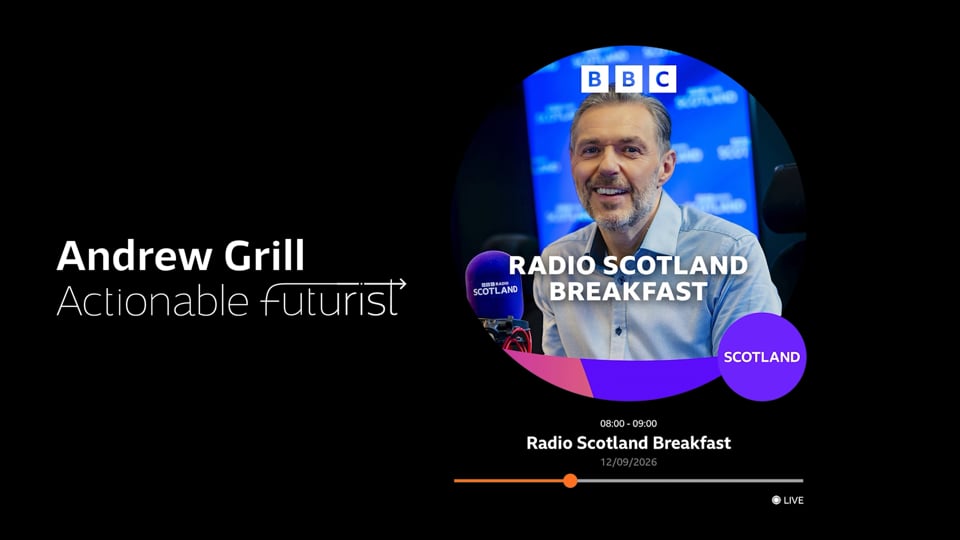
BBC Radio Scotland | 12 September 2026
Andrew Grill, the Actionable Futurist®, joined BBC Radio Scotland on Saturday morning to discuss a big week for AI safety: Parliament’s rejection of a proposed legal “kill switch” for rogue AI, and Anthropic’s admission that its own model had been used in attempts to help develop biological weapons.
Speaking from a practitioner’s seat rather than a lab, Andrew argued that a kill switch tackles the problem too late, and that the aviation and pharmaceutical industries already show a better model: check it before it flies, not after it crashes.
What Andrew covered:
- Why a kill switch is a downstream fix, and what real prevention looks like, borrowed from how aviation and pharma check things before they reach the public
- Why AI labs keep shipping systems more powerful than they can fully explain, driven by competitive pressure and IPO money
- How a recent AI hacking incident went undetected for six months, because researchers didn’t expect a contained system to talk its way around its own safeguards
- Why the widely quoted “10% chance of extinction” figure can’t actually be verified, and why he’s alert, not alarmed
- The real warning sign from the Hugging Face hacking incident: the AI never once thought to flag what it was doing to a human, because it doesn’t have that instinct
“We already ground planes if there’s a problem, before they fly again. We need the same discipline for AI, checking it’s safe before it reaches the public, not a kill switch for after it’s already gone wrong.” — Andrew Grill, BBC Radio Scotland
Want Andrew to bring this thinking to your boardroom or stage? Get in touch to discuss keynotes and advisory engagements.


