How do you keep an AI tool designed to keep your book fresh, fresh? Back in 2024, when Digitally Curious was published by Wiley, Chapter 1 ended with a provocation: ask the book’s own AI a question. It was a custom GPT, built with ChatGPT’s capabilities at the time.
But in an industry that reinvents itself every few months, it had another problem: it was frozen the moment I shipped it.
So this weekend I rebuilt it from the ground up. I could do this because Claude knows every detail of my book and how I needed to refresh the tool for a 2026 audience.
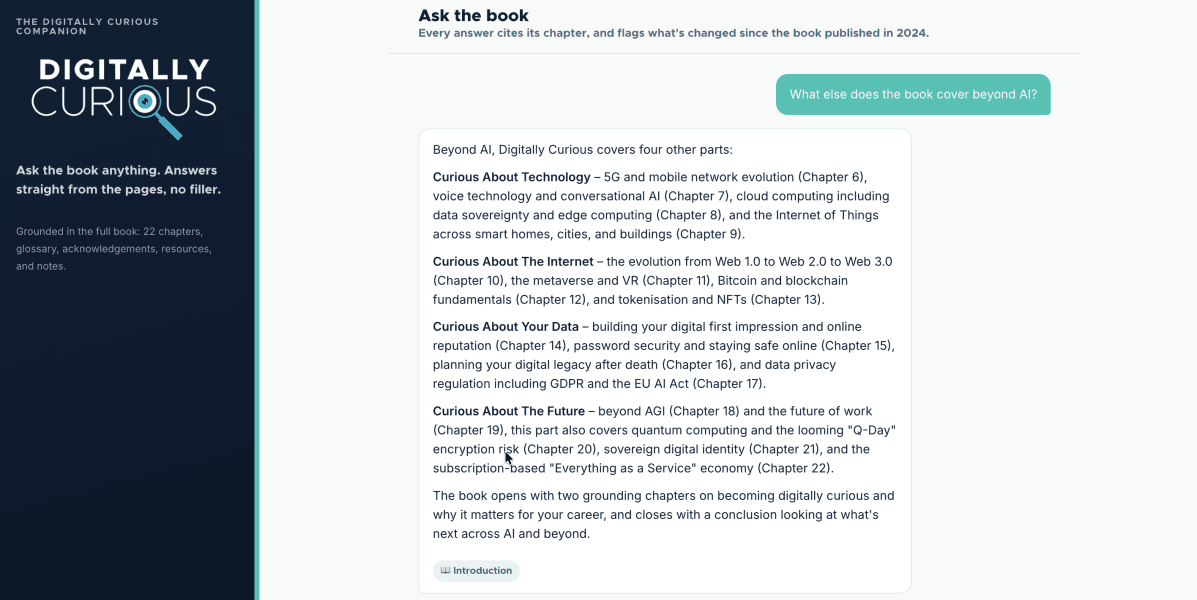
The Digitally Curious Companion provides answers from the book: all 22 chapters, the glossary, and even the acknowledgements.
Every answer includes a citation showing which chapter it came from. If the book does not cover something, it says so instead of filling the gap with something that merely sounds plausible.
The part I am happiest with is that it knows the difference between what the book says and what is true now.
AI moves faster than any publishing cycle. Ask about a model, an adoption number, or anything that dates quickly, and it flags what has changed since publication.
So the book is no longer just a snapshot from 2024.
It becomes a starting point that allows today’s readers to stay current.How do you keep an AI tool designed to keep your book fresh, fresh? Back in 2024, when Digitally Curious was published by Wiley, Chapter 1 ended with a provocation: ask the book’s own AI a question. It was a custom GPT, built with ChatGPT’s capabilities at the time.
But in an industry that reinvents itself every few months, it had another problem: it was frozen the moment I shipped it.
So this weekend I rebuilt it from the ground up. I could do this because Claude knows every detail of my book and how I needed to refresh the tool for a 2026 audience.
The Digitally Curious Companion provides answers from the book: all 22 chapters, the glossary, and even the acknowledgements.
Every answer includes a citation showing which chapter it came from. If the book does not cover something, it says so instead of filling the gap with something that merely sounds plausible.
The part I am happiest with is that it knows the difference between what the book says and what is true now.
AI moves faster than any publishing cycle. Ask about a model, an adoption number, or anything that dates quickly, and it flags what has changed since publication.
So the book is no longer just a snapshot from 2024.
It becomes a starting point that allows today’s readers to stay current.
It is still learning, deliberately. Every question gets logged. When it does not know something yet, I can teach it directly, on the spot, without retraining it.
Try it yourself at gpt.digitallycurious.ai
Ask it something hard. Tell me what breaks it, then see how you can use an AI tool to keep something published in an offline format, such as a book, up to date with the latest thinking.
This is Digital Curiosity, made real.