
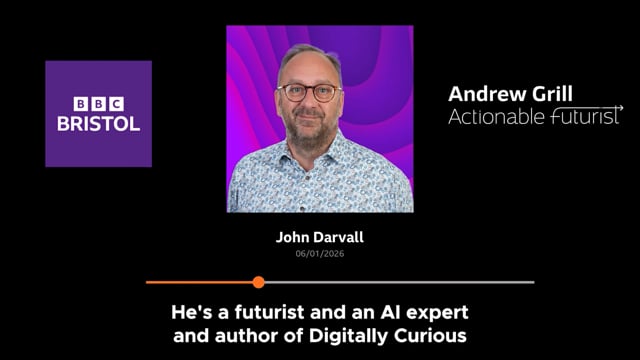
In 2026, the real SEO battle is no longer about page one on Google, but about becoming the only trusted answer AI shows your customers. I was back on BBC Radio discussing this, exploring how AI-powered search will reshape how people discover brands and information.
On air, John Darvall and I talked about how Google’s AI mode is accelerating the shift from “10 blue links” to a single, conversational response, where your brand either appears as the single answer or not at all.
This changes the game for every organisation that has relied on traditional search strategies, because authority, clarity and trust signals now matter more than keywords and clever headlines.
We also dug into what is coming next, from AI-powered advertising embedded directly into answers, to quantum computing and the future “Q-Day” moment that will force a fundamental rethink of how we secure data and digital identities.For leaders, the opportunity is to become a reliable source of truth that AI tools choose to surface again and again, rather than being lost in the noise of the wider web.
If you are digitally curious about how AI search, quantum computing and personalised assistants will reshape how your customers find and trust you, you can listen to the whole BBC Radio interview below and share it with your team to start the right conversations.
In 2026, search shifts to ask. Are you ready?
What can we expect to see from technology in 2026?
To kick off 2026, Global Futurist and AI Expert Andrew Grill was back on Radio Bristol with John Darvall to talk about the tech we can expect in 2026 and how this will impact society and cultural trends.
Andrew Grill & John Darvall BBC Radio Bristol Interview Transcript
John Darvall
Last year saw huge advancements in tech, technology, not least of which, of course, in artificial intelligence, AI, more and more people are now using the likes of chat, GPT and other generative AI to do mundane searches online or even use it as a bit of a digital assistant. So what can we expect in the next 12 months with digital and technology advancing at the pace that it is little earlier, I spoke to Andrew grill. He’s a Futurist and an AI expert and author of digitally curious so let me talk
Andrew Grill
about something that people probably haven’t heard about. Yeah, we’re going to hear more and more about quantum computing now. In a nutshell, quantum computing are computers that are massively fast and scalable. And one thing that people haven’t heard about probably is a thing called Q day, quantum day. Or Q Day is the day when quantum computers will be able to decrypt everything currently encrypted. Now, experts say it could be three to five years away. I think it could actually be by the turn of the century. So we’re going to have to get smarter about how we protect ourselves.
John Darvall
It’s interesting you said quantum computing, because you and I have spoken a lot in 2025 about AI, and we’ll come to that in just a moment. But I’ve been doing some reading on quantum computing. This is going to change everything. These computers, unless I’m mistaken, Andrew, have the ability to do things in a fraction of a second that would take a normal computer months or even years.
Andrew Grill
Oh, absolutely. And what companies like Google and Microsoft are doing, there’s a bit of an arms race happening to make them faster and faster, but we won’t see them on the street anytime soon. They’re the size of a refrigerator, and they have to be chilled to minus 273, degrees Celsius. So it means that you’ve got to be a large company to have one, but you’re right, once you have the power on your hands, you can solve problems that were unimaginable years ago.
John Darvall
So if you marry that to AI, which is something that we’ve been talking about, what do you get? It’s interesting.
Andrew Grill
Actually, you can’t just plug an AI system into a quantum computer, because they deal with things differently. But let me give you an example, a problem that quantum computers can work on very well. When there’s a big weather event and all the planes are in the wrong place and the crews are on the wrong place, think about the math amenable combinations of finding out how to reset from that a quantum computer could do that in seconds. It might take days, and we haven’t got days sometimes when aeroplanes are out of whack.
John Darvall
So that’s a very good example. And we talked about AI last year. A lot of people not using AI in the way that the inventors of AI thought it was going to be used. Are we going to see that become a more dominant force this year? Because it’s certainly changed employment. It’s perhaps not in quite the way that people were expecting, but it has changed a lot of things already, hasn’t it?
Andrew Grill
I call it the coffee shop test, when the person next to you is actually talking about the technology that you and I have been talking about for a while, I think what people are seeing, especially when they Google something before they were given 10 blue links to go and look at. Now, in many cases, especially in the UK, you actually get the answer in front of you, what we call one shot. So we’re going to have people now saying, rather than searching, I’m actually want answers to my questions instantly. And people are going to expect that, which means it changes how we interact with search engines for the first time in 20 years,
John Darvall
and that that has consequences, not least of which, of course, clicks were a way that these companies made money, that you would have a sponsored click at the top, and that, you know, you pay for it, and that would make you money if you’re getting a one shot, as you put it, one answer, how do you make money out of that?
Andrew Grill
Well, get ready for AI powered advertising. So this, this result is brought to you by so ever, and they’re linked to that. And I think Google, for a while thought, how do we replace our blue clicks, where we make some money into AI one shot? I think you’re going to start to see in 2026, AI powered advertising.
John Darvall
So that’s going to be something else that we’ll see on our computers. Are we going to get the still get the choice to have an old search or a new search, or are we being driven towards AI by the big boys?
Andrew Grill
Well, we are and we aren’t actually. It costs Google and others a lot more money to provide that one shot because it’s doing a lot more processing behind the scenes. I think what will happen, though, is that consumers have an expectation to get an answer rather than a link, but then it comes down to trust. Do we trust the answer? And we’ve spoken before about believing these AI systems. Where do they come from? Is that one short answer? Do I believe that? Do I need to go and look further to make sure I’m getting the right answer?
John Darvall
Well, that comes to the heart of something we talked about a lot last year, isn’t it? Is that AI is a start point, it isn’t the end point. Are we ever going to get to a point where it is the end point? Because my problem is that I’ve always thought that the database itself is corrupt, isn’t it? I mean, it’s where it’s getting is information, is it in of itself, corrupt?
Andrew Grill
Well yes and no. I think the more I’m using websites like chat, GPT and perplexity, the more it learns about. Me, it knows what I’m looking for. It knows where I go for the source of truth. And I think we’ll find these systems getting smarter and started to say, actually, or won’t, look on the random open internet and a Reddit search, I’ll look for a source that Andrew has used before and he trusts. Because it’ll come down to what’s the source of truth, and who do I believe?
John Darvall
Andrew? Great to talk to you again, first time in 2026 I know it won’t be the last time. Andrew grill, he’s a Futurist and an AI expert and author of digitally curious.


