
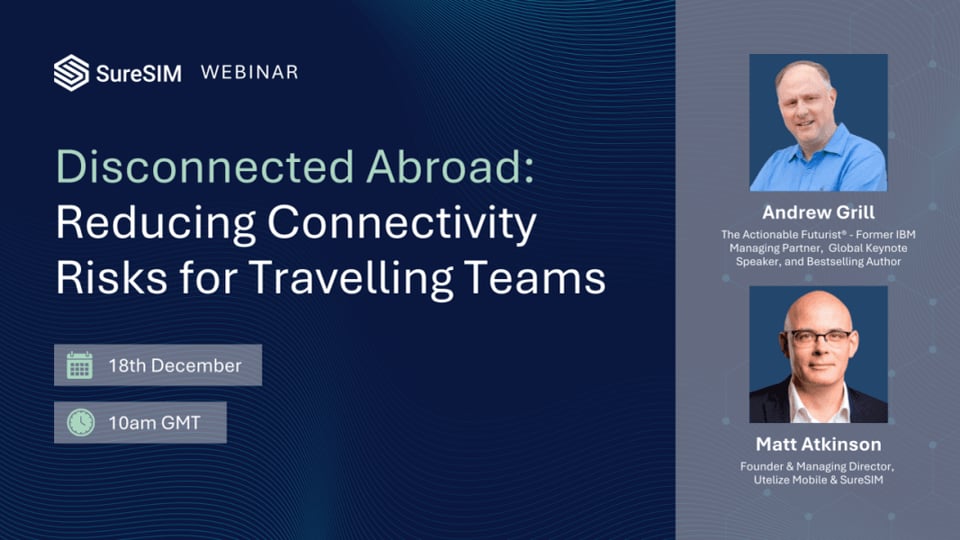
Join Andrew Grill and Matt Atkinson from Utelize Mobile for a webinar about the hidden cost of “Going Dark” for teams when travelling.
When high-value employees travel internationally, businesses are right to be concerned about roaming data “bill shock”, which can often quickly escalate into thousands of pounds of unexpected costs.
However the real business impact and hidden costs start to kick in when Execs, VIPs and sales teams find themselves cut off from mobile connectivity and left in the dark.
From the lost hours of productivity, stress at borders when trying to access important travel documents, security exposure from being forced to connect to insecure public Wi-Fi, and the reputational damage and service issues that come with being disconnected, the real impact on users and the business is material.
This session uses real stories and on Eliminating Mobile Bill Shock (from our companion eBook available below) and enterprise-focused insights on how next-generation enterprise eSIM services can provide global teams with the multi-network resilience needed to stay connected, whilst also providing IT and finance with real-time total cost & usage control and improved financial governance.
Replacing outdated legacy mobile roaming with a software-defined, compliant and global connectivity management platform.
What the webinar covered
In a fireside-style conversation, Andrew and Matt unpacked why connectivity has become a business continuity issue rather than a line on the phone bill. Around 60% of business travellers say fast, reliable internet is their top priority on the road, and a single connectivity failure can derail an entire trip: a missed boarding pass, a stalled deal, an executive forced onto hotel Wi-Fi to approve a payment.
They walked through the three risks of going dark abroad: financial (lost productivity and surprise bills), operational (teams who cannot reach systems or each other) and compliance (security exposure and reputational damage). Enterprise eSIM platforms answer this with multi-network resilience across around 200 countries, so a traveller simply switches to the next network instead of disappearing.
What this means for leaders
- Treat connectivity as duty of care, not a procurement line item.
- CIOs and CFOs should rethink mobile strategy together, combining resilience for travellers with real-time cost visibility for finance.
- Pilot with one cohort first, such as frequent flyers or field teams, before rolling out.