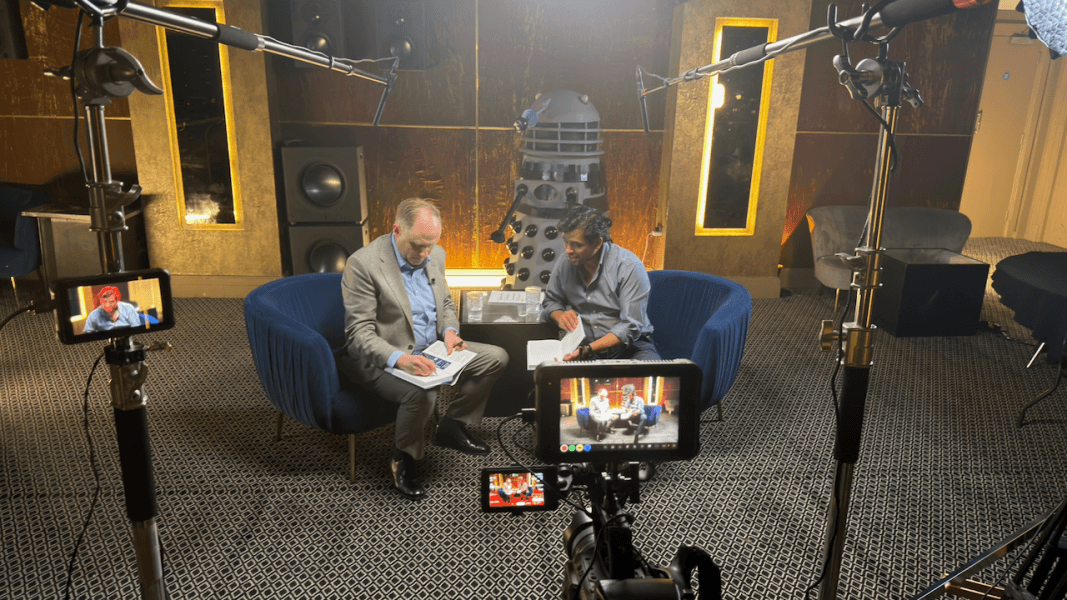
What’s the next frontier for AI? After a day spent with Marcus Paleti and team recording episodes of the Protocol Blue Podcast, it could be Physical AI.
So what is physical AI? Physical AI is the fusion of artificial intelligence with physical systems: robots, vehicles, and devices, empowering machines to perceive, reason, and act autonomously in the real world using sensor data and adaptive decision-making.
Andrew was joined by a number of other leading voices in this space including:
Jonathan Berry
Bernd Mattner
Mansoor Nasir
Matthew Wakefield
Dominika Haberova
Kyle Thomas
Yes, that is an original Dalek from the BBC TV series Doctor Who in the background.
What the panel covered
Over a full day of recording, the conversations ranged from why startups struggle to win market traction to the role of AI and autonomous systems in defence, where rapid prototyping is becoming a competitive necessity. The panel discussed DeepMind’s work on protein folding and cancer diagnostics, the enormous compute costs behind today’s models, and Q Day: the moment quantum computers can break the encryption that protects today’s data.
Children, screens and the skills that will matter
Andrew drew a direct line between parenting and corporate life. In both, leaders need to understand the tools people are using rather than banning them. He warned about the instant gratification built into games and smartphones, and argued that AI can finally deliver personalised learning at scale, while social interaction, public speaking and critical thinking become the skills that set people apart.
What this means for leaders
- Get ready for physical AI: the next wave puts AI into robots, vehicles and devices, not just screens.
- Put Q Day on the risk register and start planning for quantum-safe encryption.
- Build AI safety and responsible use into training for staff and students.
- Protect the human skills: critical thinking, communication and judgement.
Look out for the podcast series soon, and in the meantime, grab a copy of The Immutable Era of Physical AI impact report via this link.