
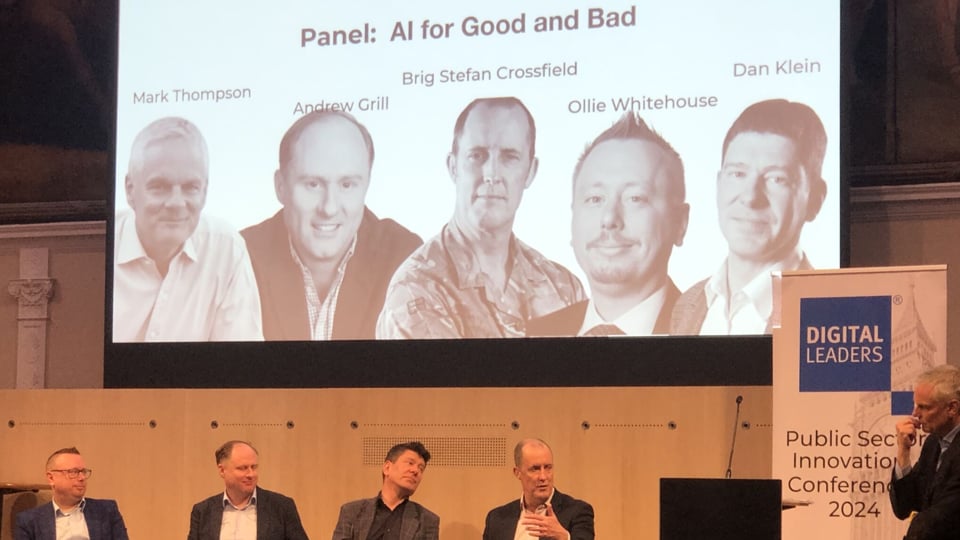
Andrew spoke on a panel titled: “AI for good and bad” at the 6th annual Public Sector Innovation Conference in London with:
Mark Thompson, Professor in Digital Economy, University of Exeter Business School
Brigadier Stefan Crossfield, CDO – British Army / Principal AI Officer
Ollie Whitehouse, CTO – National Cyber Security Centre
Dan Klein, Head of AI and Data – Zühlke Group
This year’s Public Sector Innovation Conference will look at interesting ways people use AI to innovate in our public services.
A new conference format will alternate thoughtful keynotes and panel discussions with lots of quick-fire examples of early “lighthouse” projects, as we ask, ‘what are the challenges specific to using AI to deliver public services?’ and, ‘what are the lessons learnt so far in the journey from procurement to delivery?’
Event overview
Generative AI burst into the public consciousness on 30th November 2022 and already has 100 million regular monthly users. Gen AI is already being used in small pockets internally within public sector organisations and in a much more limited way to support direct citizen interactions.
However, usage remains piecemeal, as its implementation seems to hang mainly on the knowledge and existing skills of CTOs across the Government. In May 2023, the Independent Committee on Standards in Public Life argued that public sector organisations are not sufficiently transparent about their use of AI and that it is too difficult to find out where machine learning is currently being used in government.
More recently, the EU Bloc has called for less restrictive thinking by Governments when regulating generative AI, arguing that there was a far greater risk of such behaviour stifling innovation.
Most recently, in November 2023, the UK government held the first Global Safety Summit to bring together international governments, leading AI companies and civil society groups to consider the risks of AI, especially at the frontier of development.
During the day, the event will consider the opportunities such technologies present for how our public services are currently organised and run.
Can departmental structures and traditional organisational silos be modernised so we could potentially create a public sector LLM as well as cross-departmental data lakes?
If achieved, the benefits could free up resources and staff to deliver more valuable frontline tasks and reduce costs. The conference day has three interlocking themes.
Each session will comprise a keynote, a panel to discuss the topic in detail, and five lighthouse examples of projects already underway to inspire the audience.
The audience will be informed about how the public sector should engage with AI and will have a good understanding of the ethics, risks, and benefits of using AI to deliver public services.
Session overview
How do we strike the balance between AI being used for bad (e.g. lowering the barrier to entry to criminality, or for cyber attacks) and AI being used for good (e.g. allowing otherwise marginalised societies in the global South access to technologies, or advancements in health research).
So far, the global narrative around AI has been largely a negative one, reinforcing how AI is being used for bad and is not exploring enough of the positive opportunities that come from AI.
Now in its 6th year, the 2024 PSI conference will scrutinise the potential to use AI to make our public services much smarter, efficient and more productive. A particular focus will be on exemplar, ‘lighthouse’ projects already leading the way across different departments.
I’ll be bringing along insights I shared with the Cayman Islands Government last month, and I expect to be taking away many excellent insights from the PSI event for future events and my book, Digitally Curious.
It should be a very interesting discussion.More information is available on the event website.